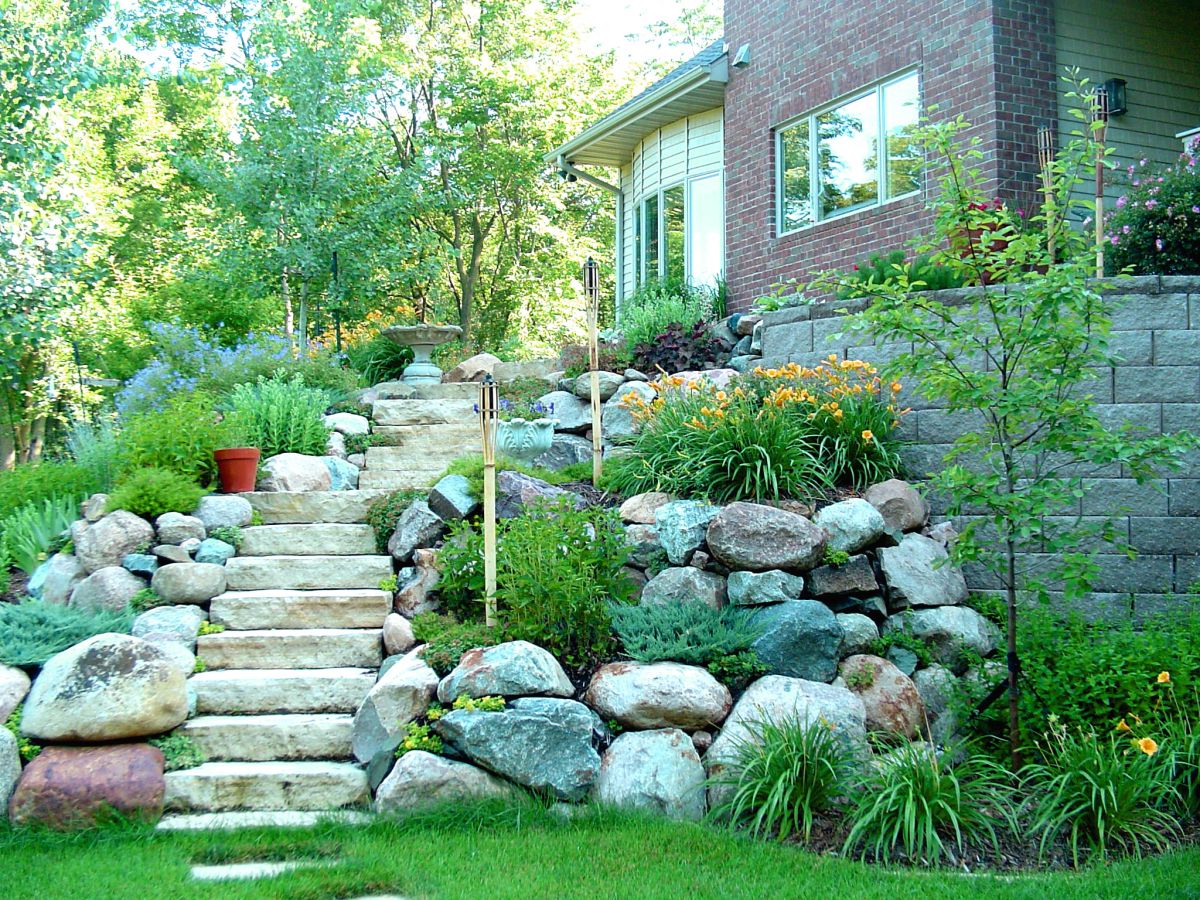
When designing a retaining wall for your Michigan property, one of the most important decisions you’ll make is choosing the right material. Two of the most popular—and most effective—options are boulder retaining walls and manufactured block retaining walls. Both are strong, durable, and capable of solving erosion and slope challenges, but each brings its own advantages and design style.
If you're unsure which direction to go, you're not alone. Many Oakland County homeowners ask whether a natural boulder wall or a clean, engineered block wall is better for their yard. The right choice ultimately depends on your landscape style, functional needs, and overall vision.
In this blog, we’ll compare boulder walls vs. block walls side-by-side so you can confidently choose the retaining wall that fits your property best.
Before we compare the differences, let’s cover what both wall types offer:
✔ Strong soil retention
✔ Excellent erosion control
✔ Long-term durability
✔ Structural stability when installed correctly
✔ Ability to handle Michigan freeze-thaw cycles
✔ Low maintenance over time
✔ Customizable height and length
Both are exceptional choices—but the right option comes down to your aesthetic preferences, yard conditions, and project complexity.
Boulder walls are built using large natural stones that are strategically stacked to form a durable, organic-looking retaining structure. Each boulder varies in size, shape, and color, creating a wall that feels timeless and connected to nature.
Block walls are constructed using manufactured concrete blocks designed to interlock. These blocks come in various shapes, colors, and textures, offering a clean, uniform appearance ideal for modern landscapes.
Below is an in-depth comparison to help you understand how each material performs.
Boulder walls blend seamlessly into outdoor environments and often feel like part of the land itself.
Block walls deliver a crisp, architectural look.
Both wall types are extremely strong—but their strength comes from different places.
Ideal for large-scale projects or challenging terrain.
Block walls are ideal when precision engineering is needed.
Both are long-lasting options, but boulders often outlive manufactured materials.
Costs vary based on access, wall size, and material availability.
Pricing can be similar or even lower than block walls for large projects, depending on the stone source. Installation requires heavy equipment but fewer components.
May be more cost-effective for small decorative walls. Larger structural block walls usually cost more due to additional materials, footings, and reinforcement.
Both require expertise, but in different ways.
✔ You love natural, earthy landscaping
✔ You have a steep slope or large grade changes
✔ You want a wall that lasts generations
✔ You want a rugged, bold landscape statement
✔ You’re looking for lower long-term maintenance
✔ You prefer clean, structured designs
✔ Your home has a modern architectural style
✔ You want color or texture customization
✔ You need precise engineering in tight spaces
✔ You want a polished front yard appearance

Driftwood Landscape will help you choose the right retaining wall material and build a structure that combines strength, beauty, and long-term durability.